In short
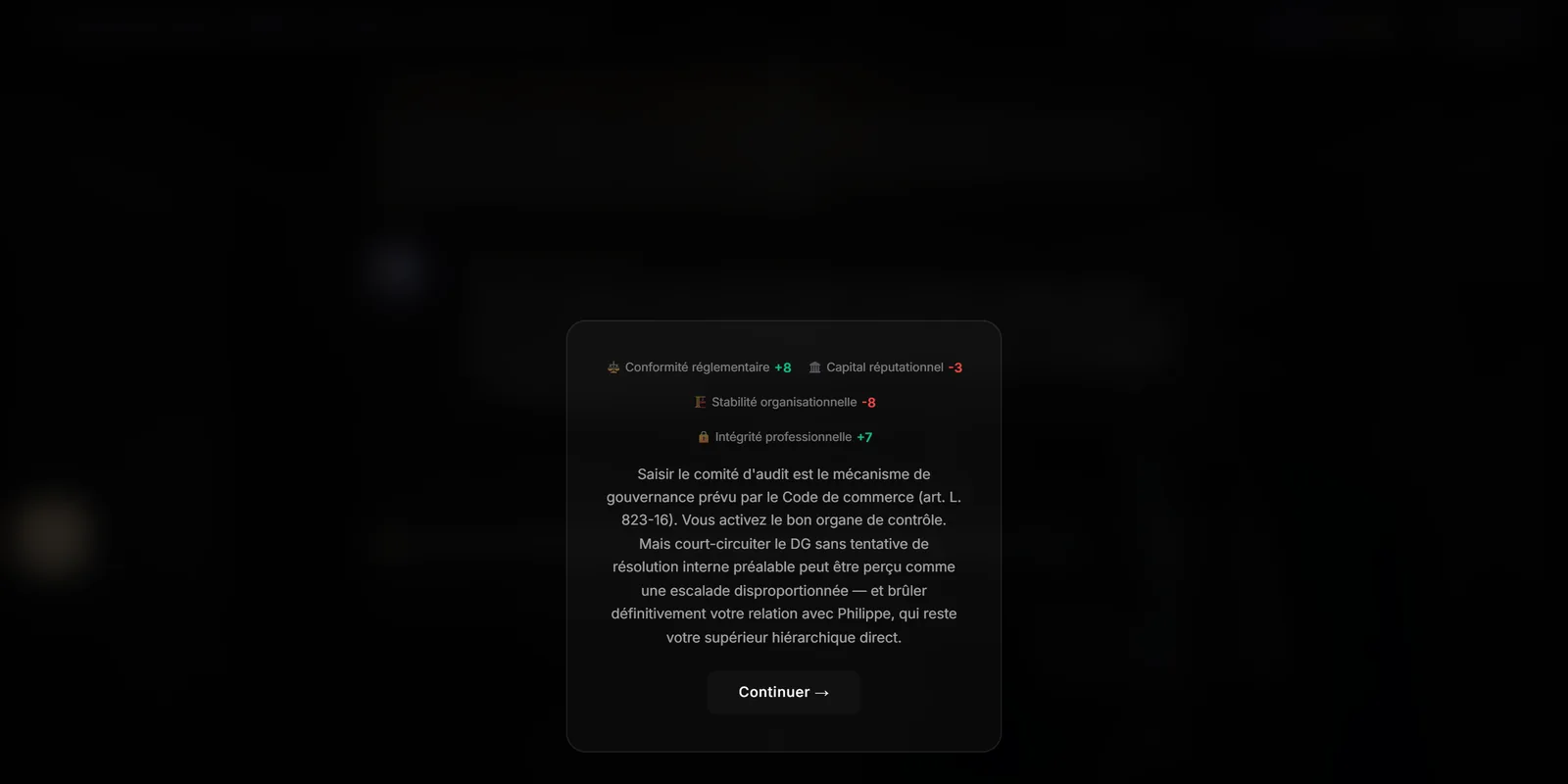
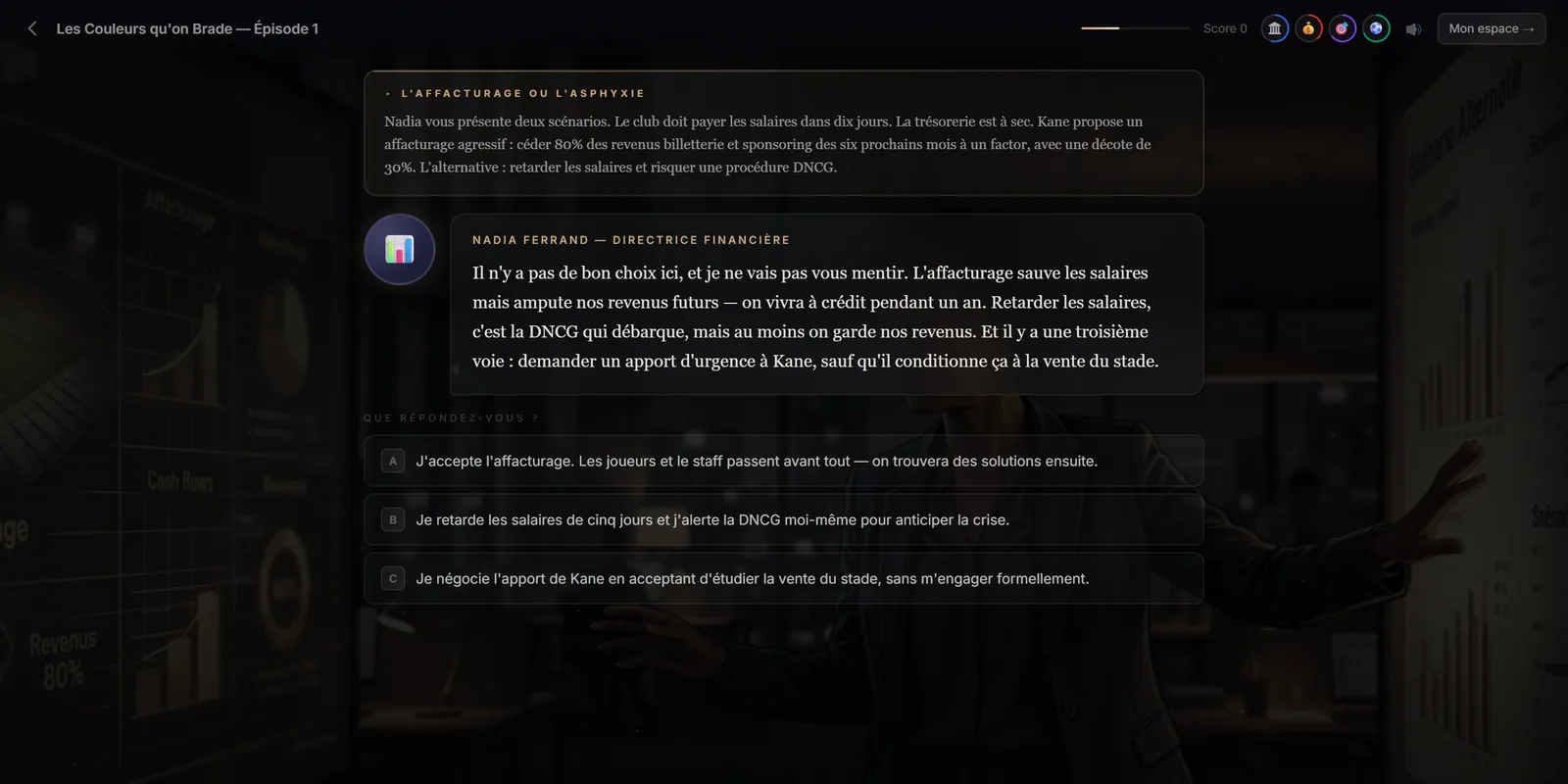
A dilemma scene offers three or four options that all have a cost. It awards no points: no option is “the right one”. Each choice has marked effects on the scenario's gauges, which the learner sees immediately, and steers the rest of the story. Immersio's engine places at least one from intermediate level.
At a glance
- What the learner does
- Trades off options that all have a cost.
- Options
- 3 or 4, with no right answer.
- Measured
- No points; only the effects on the gauges.
- In the engine
- At least one from intermediate level.
- Editable by hand
- Yes, in the studio editor.
Why put a dilemma in a serious game?
Because that's where professional judgement is formed. Multiple choice trains learners to recognise the best action; a dilemma trains them to choose what they are willing to lose, and to be able to explain it. It's the “evaluate” level of Bloom's taxonomy: weighing conflicting criteria and taking a position.
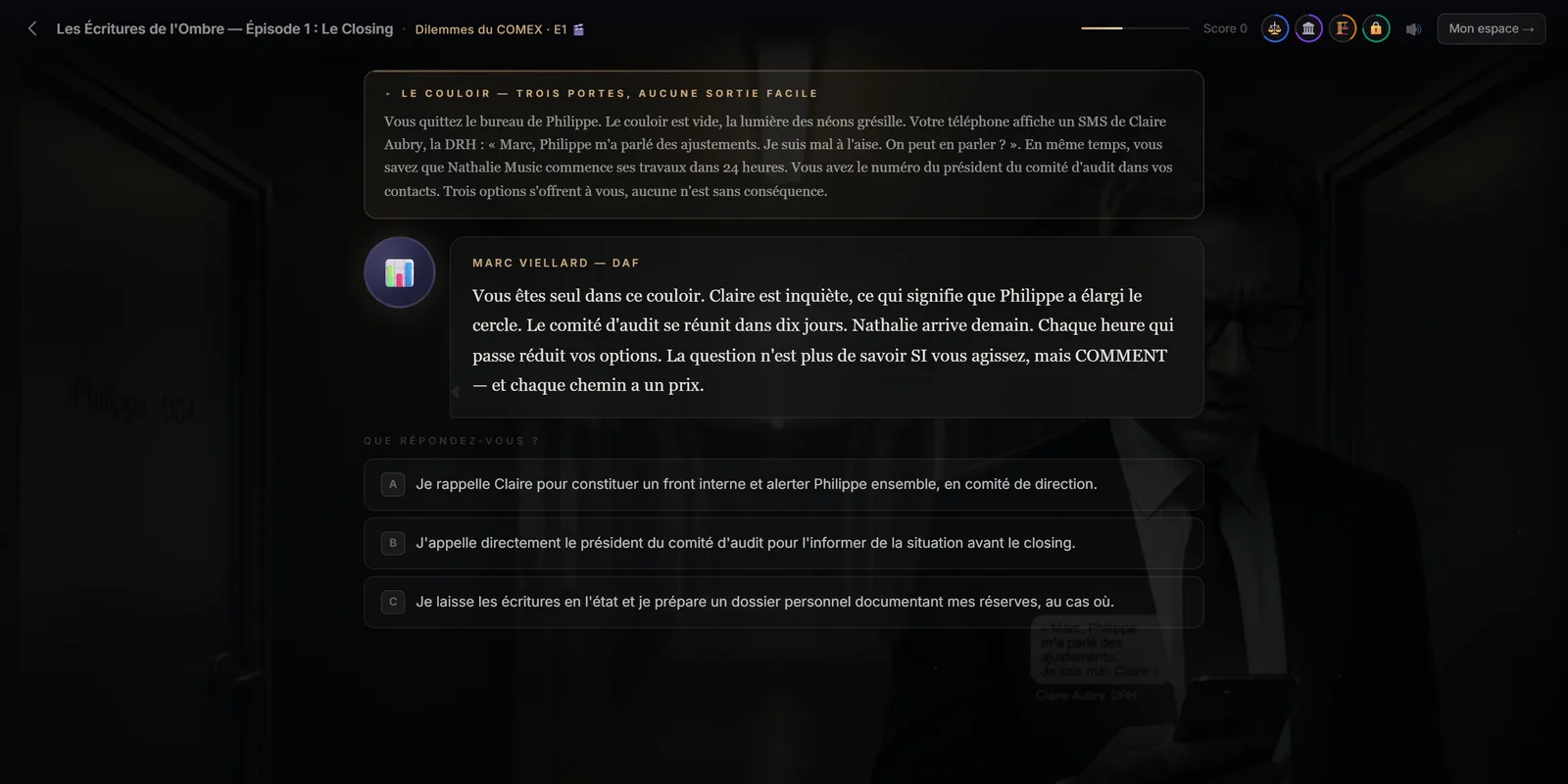
The absence of a grade changes the learner's stance. They stop trying to guess what the trainer expects and reason about consequences. The gauges then show them what their trade-off cost and gained, without any value judgement.
How does the learner measure the consequences of a trade-off?
Through the gauges. After the choice, each one moves, often in opposite directions: what protects compliance can weaken the organisation's stability, what saves the relationship can cost integrity. The feedback text describes what happens next, and the rest of the scenario follows from it.
How do you write a good dilemma?
- Set two legitimate values against each other, not a value against misconduct. If an option is simply dishonest, it isn't a dilemma.
- Make each cost concrete: who suffers, when, and how much.
- Keep the options realistic: ones that real professionals have actually taken in a comparable situation.
- Plan time for discussion in blended training: a dilemma is an excellent starting point for a group debate.
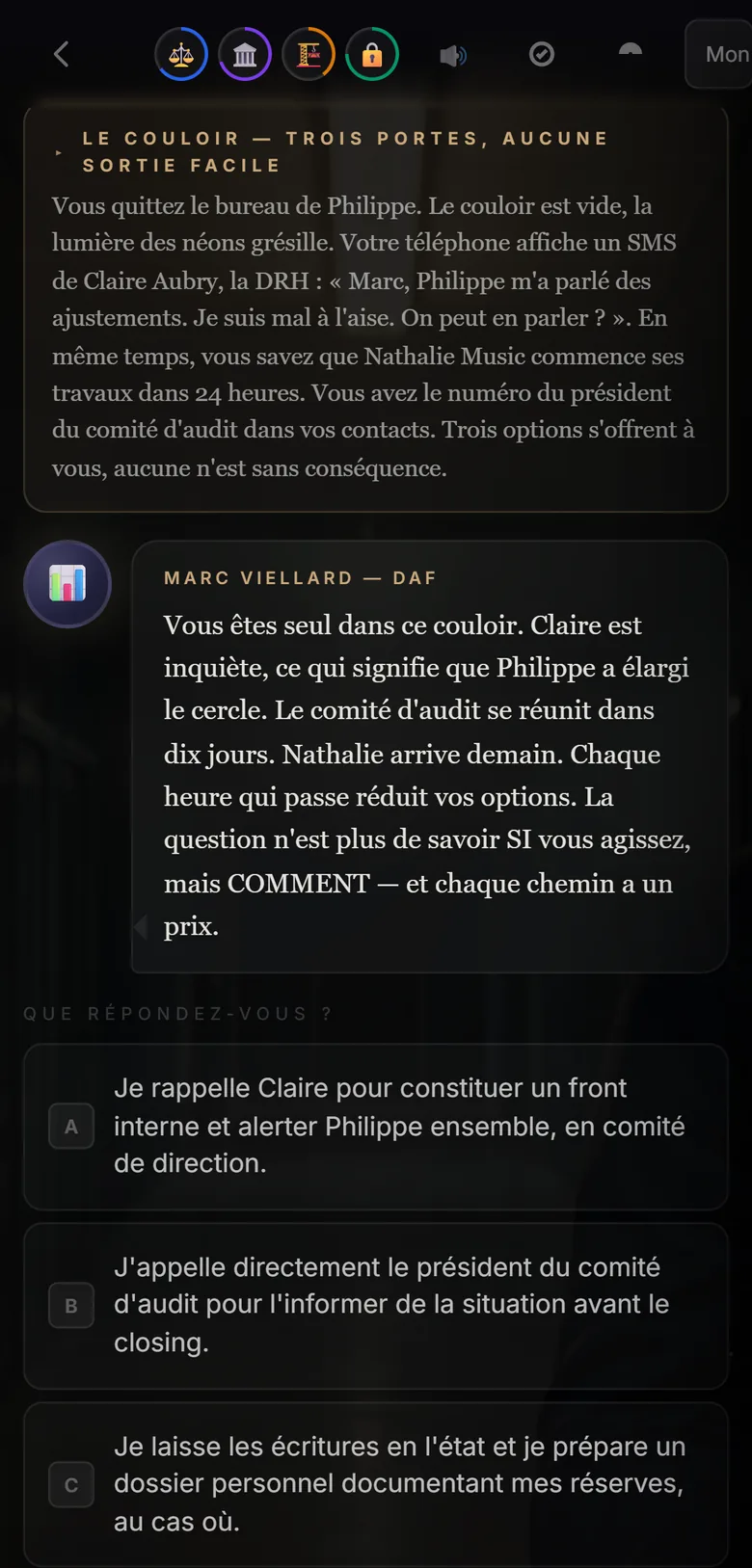
Dilemmas work particularly well in the classroom: the trainer projects the scene, the group debates, then votes for an option. Everyone can then replay alone on their phone and compare the consequences of a different trade-off.
What the dilemma doesn't do
It doesn't check knowledge and doesn't feed the score: a scenario made only of dilemmas would say nothing about mastery of the rules. Combine it with consequence-based multiple choice, which checks that the basics are in place, and an open question to have the trade-off justified.
Frequently asked questions
Does a dilemma count towards the score?
No. All its options are worth 0 points: only the consequence on the gauges counts. The scenario score measures mastery of decisions that have a better answer; the dilemma measures something else.
At what level should dilemmas be used?
From intermediate level, where Immersio's engine places at least one. At beginner level, it's better to anchor the rules first with multiple choice; you can still require a dilemma in custom mode.
Can a multiple-choice scene be turned into a dilemma in the editor?
Yes. In the studio editor, a scene's type can be switched between narrative, multiple choice and dilemma, and each option can be edited.
Create your first scenario
A training provider account gives you the studio, the scene formats and all four matrices. 7-day free trial, no credit card required, with 3 scenario generations to judge the result on your own topic. Scenarios are generated in French.
Create a training provider accountPrefer to compare first? See pricing · How it works