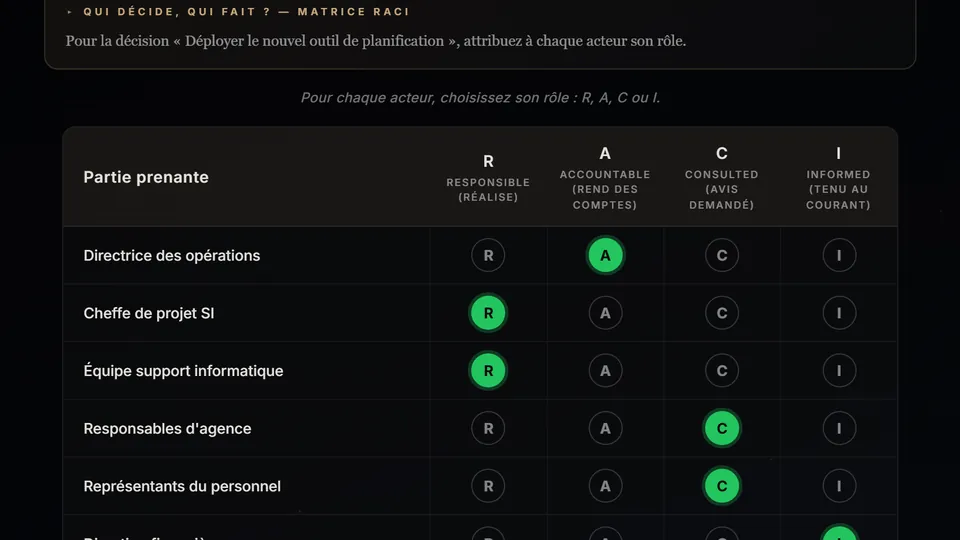
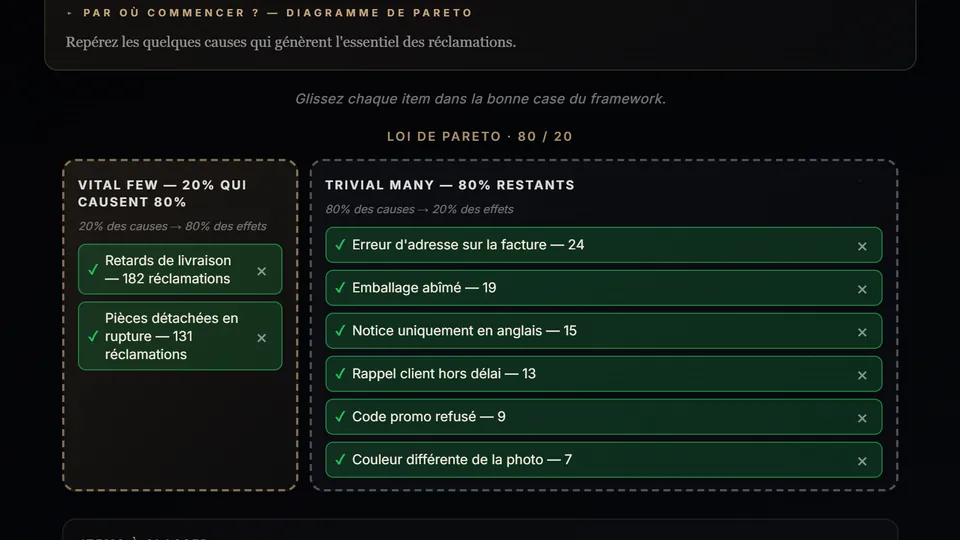
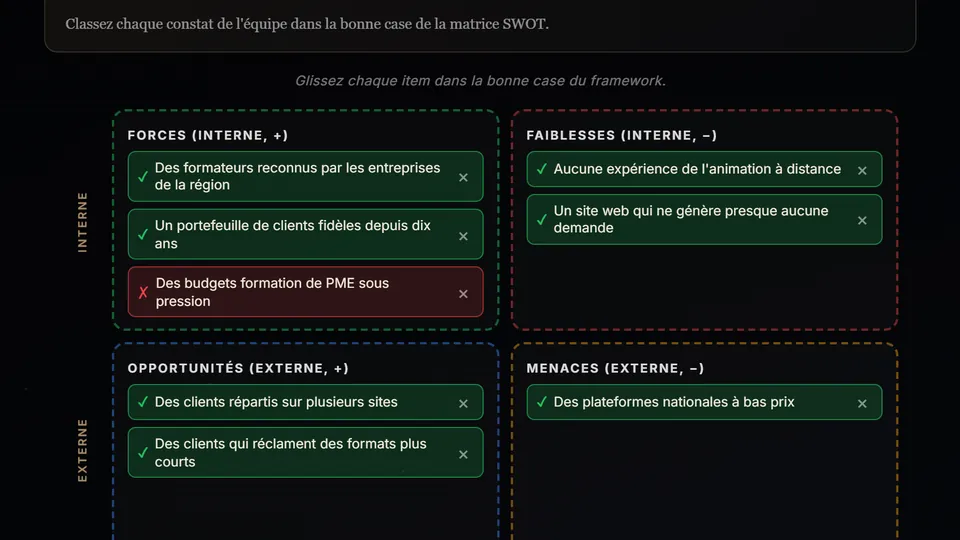
In short
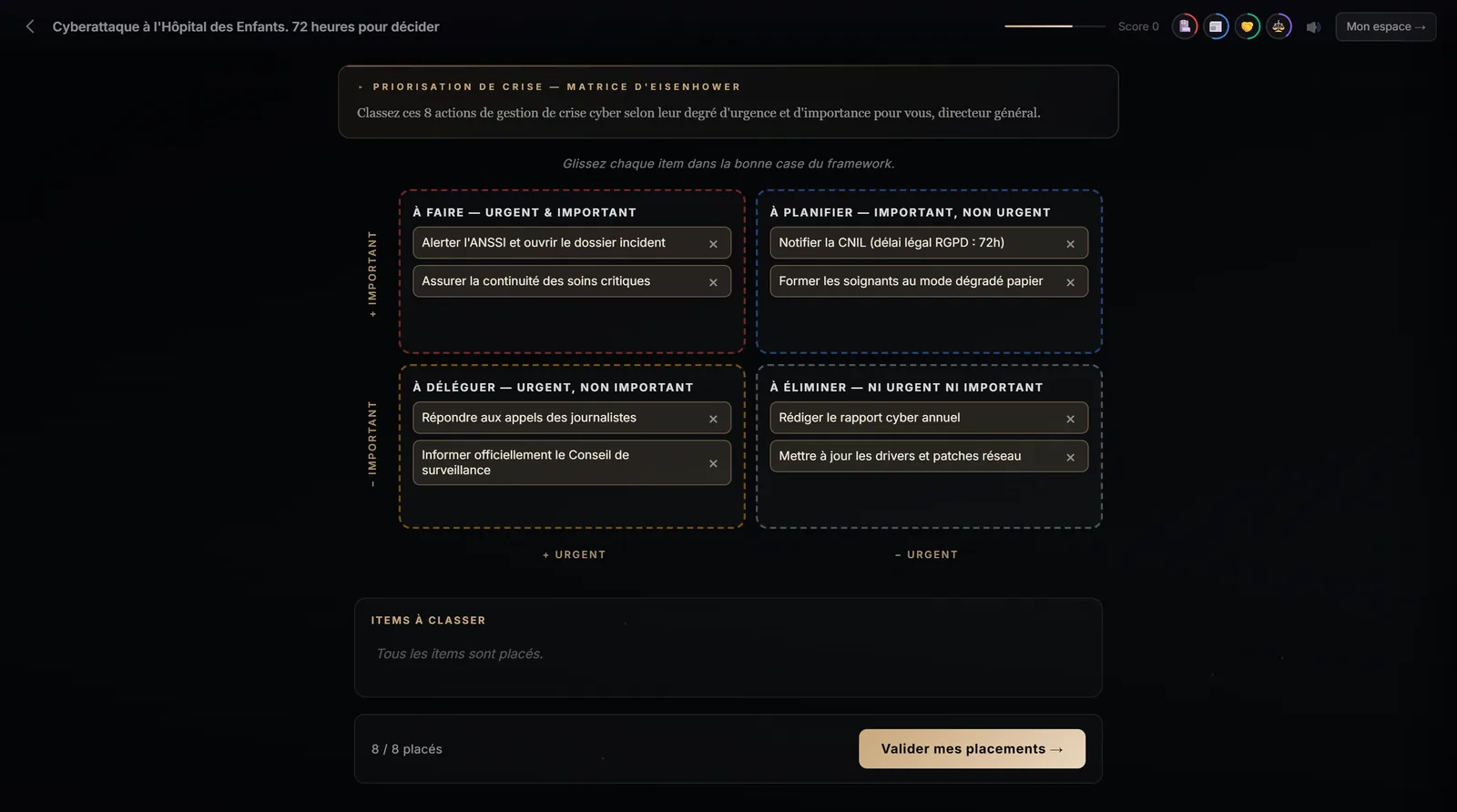
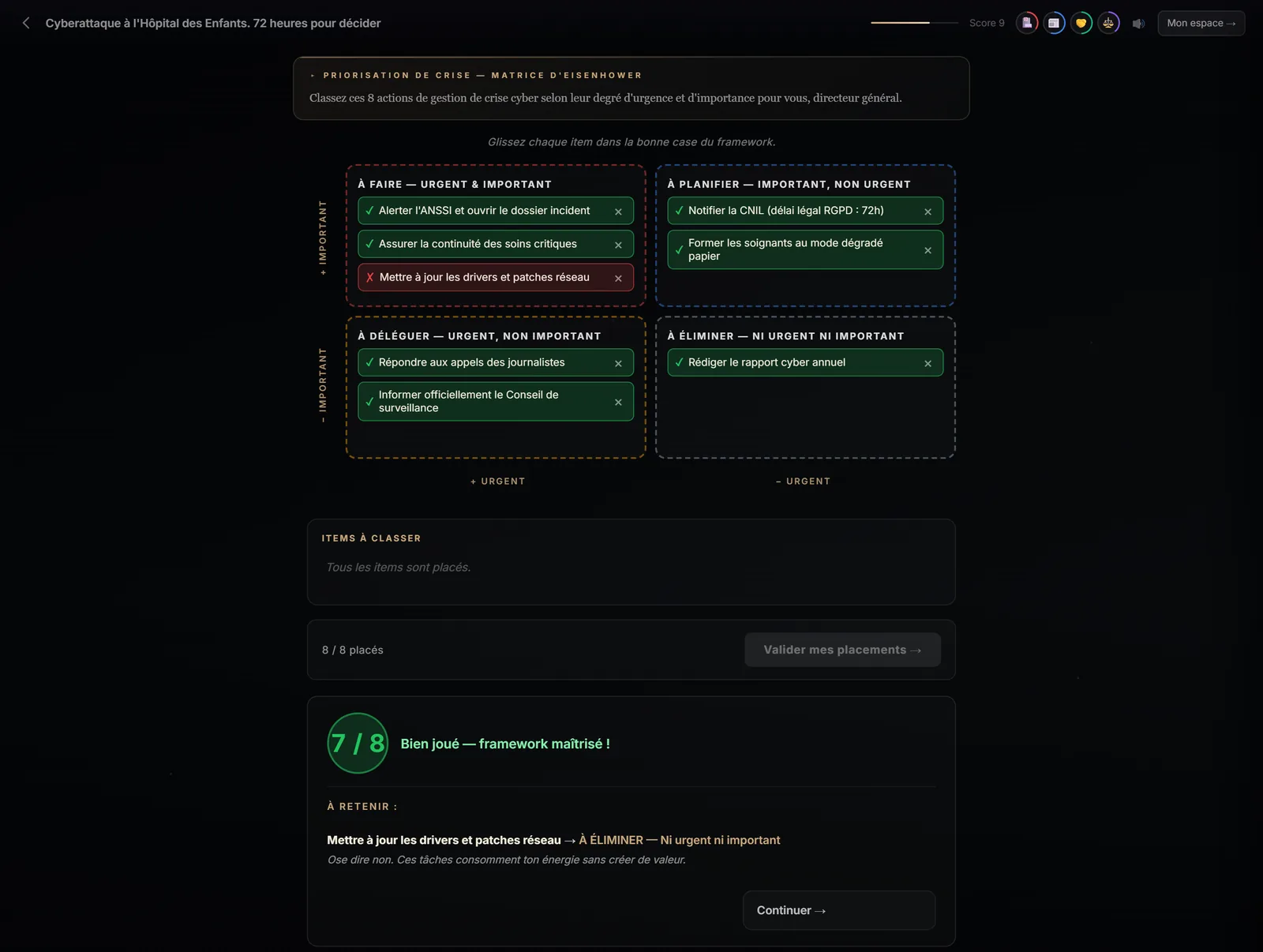
The Eisenhower matrix sorts tasks by two criteria, urgency and importance, into four quadrants: do now (urgent and important), schedule (important, not urgent), delegate (urgent, not important) and eliminate (neither urgent nor important). In an Immersio serious game, learners sort eight to twelve tasks drawn from the situation they are living through, then see their mistakes explained box by box.
At a glance
- Origin
- Attributed to Dwight D. Eisenhower; popularised by Stephen Covey (1989).
- Criteria
- Urgency (the deadline) × importance (the impact).
- Quadrants
- Do · Schedule · Delegate · Eliminate.
- Skills
- Prioritisation, time management, delegation.
- Audiences
- Managers, assistants, project managers, support functions, crisis units.
What is the Eisenhower matrix?
It's a prioritisation tool that crosses two questions: is this task urgent? (does it have a close deadline, is someone waiting?) and is it important? (does it serve my goals, my main responsibility?). It is attributed to US President Dwight D. Eisenhower, credited with the idea that what is urgent is seldom important, and what is important seldom urgent. Stephen Covey popularised it in 1989 in The 7 Habits of Highly Effective People.
| Quadrant | Urgency × importance | What to do with it |
|---|---|---|
| Do | Urgent and important | Handle it now, yourself. |
| Schedule | Important, not urgent | Block time for it: this is where most value is created. |
| Delegate | Urgent, not important | Hand it to the best-placed person. |
| Eliminate | Neither urgent nor important | Say no, or postpone without guilt. |
Why train prioritisation in a serious game?
Because prioritisation is a skill that collapses under pressure. In a classroom, in cold blood, everyone correctly places “prepare next year's budget” in “schedule”. In the middle of a crisis, with a journalist on the phone, it's another matter. The matrix scene recreates that pressure: the tasks come from the story, they carry its stakes, and the learner sorts them in the role they are playing.
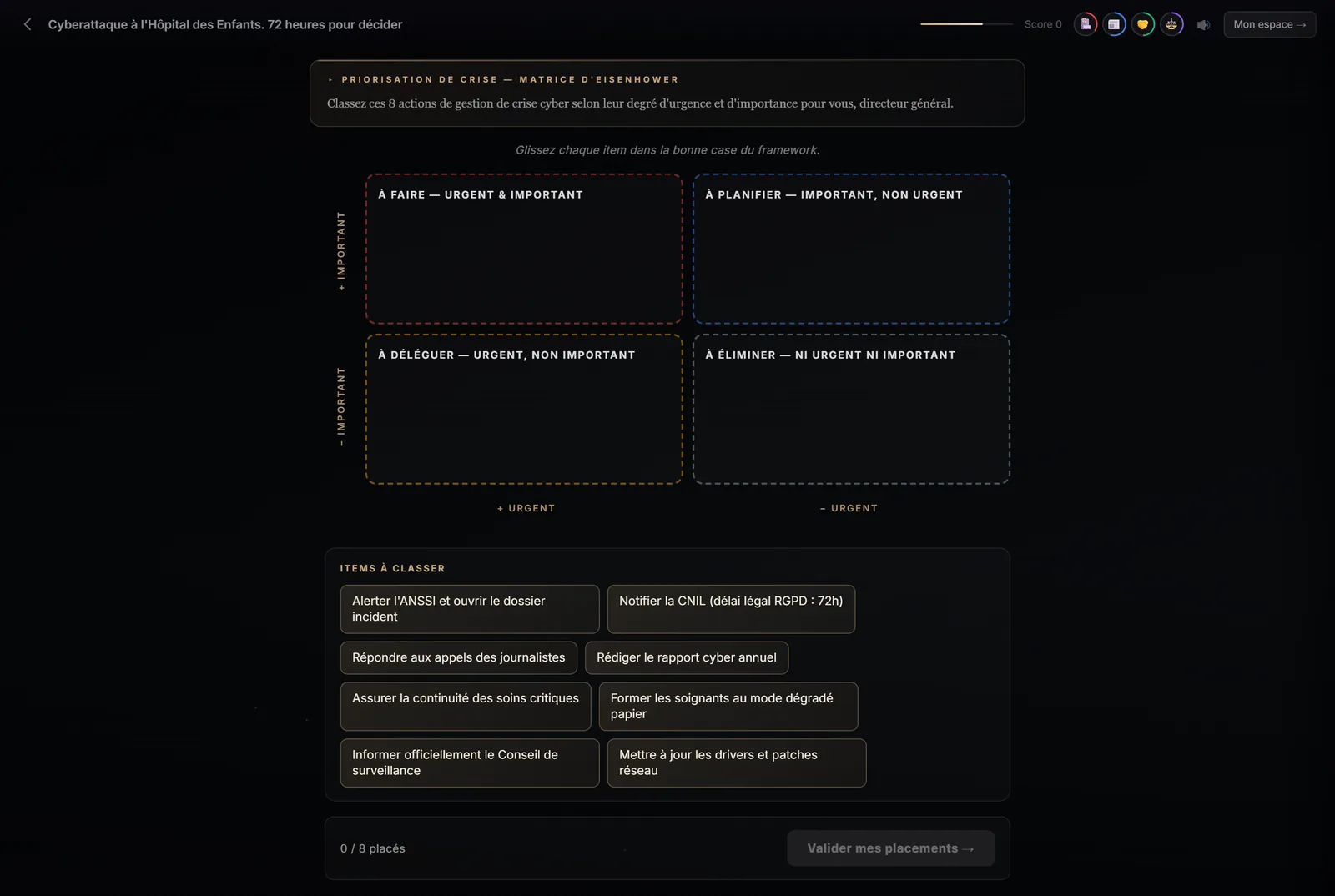
Immediate feedback does the rest. Each misplaced item is flagged with the expected quadrant and that quadrant's logic. Learners understand not only that they got it wrong, but which criterion they misapplied: they confused urgency with importance, or kept for themselves what could have been delegated.
What are the most common mistakes?
- Confusing urgent and important. A pressing request isn't necessarily decisive: this is the very mistake the matrix was designed to correct.
- Putting everything in “do”. If everything is a priority, nothing is; the “do” quadrant should stay short.
- Neglecting “schedule”. Important, non-urgent tasks (training, prevention, preparation) are the ones we keep postponing until they become emergencies.
- Confusing delegating with offloading. Delegating means entrusting the right person with the means to act, not passing a task on at random.
Which courses should use the Eisenhower matrix?
- Time management and organisation: the overloaded week, coming back from holiday, the overflowing inbox.
- Front-line management: arbitrating between requests from the team, senior management and customers.
- Crisis management: deciding what the leader handles personally and what goes to the crisis unit.
- Taking up a new role: a new manager's first month, when everything looks like a priority.
Create a serious game for front-line managers coming back from three weeks of holiday to an overloaded week: requests from the team, customer emergencies, files from senior management. The learner must prioritise their Monday-morning tasks in an Eisenhower matrix, then handle the consequences of their choices during the week. Gauges: deadlines, quality of work, team climate.
Paste it into the studio once your account is created, then adapt it to your audience. Scenarios are generated in French.
The limits of the Eisenhower matrix
It simplifies: a task can be “fairly” urgent or “rather” important, and importance depends on who is looking. That's precisely why it must be practised in context: the same item isn't classified the same way by a CEO and a department head. In a scenario, the expected classification is the one defined at creation: have it reviewed by a subject-matter expert if some items are debatable.
Frequently asked questions
What's the difference between urgent and important?
Urgency is about the deadline: the task must be dealt with quickly, someone is waiting. Importance is about impact: the task serves your goals or your main responsibility. A task can be one without the other, which is the whole point of the matrix.
Who invented the Eisenhower matrix?
It is attributed to US President Dwight D. Eisenhower, credited with the distinction between urgent and important. Its four-quadrant form was popularised by Stephen Covey in 1989.
How is the Eisenhower matrix scored in an Immersio serious game?
The score is the share of items correctly placed. The pass threshold is 70% (80% at expert level); below it, learners see their mistakes explained and can try again.
Create your first scenario
A training provider account gives you the studio, the scene formats and all four matrices. 7-day free trial, no credit card required, with 3 scenario generations to judge the result on your own topic. Scenarios are generated in French.
Create a training provider accountPrefer to compare first? See pricing · How it works