In short
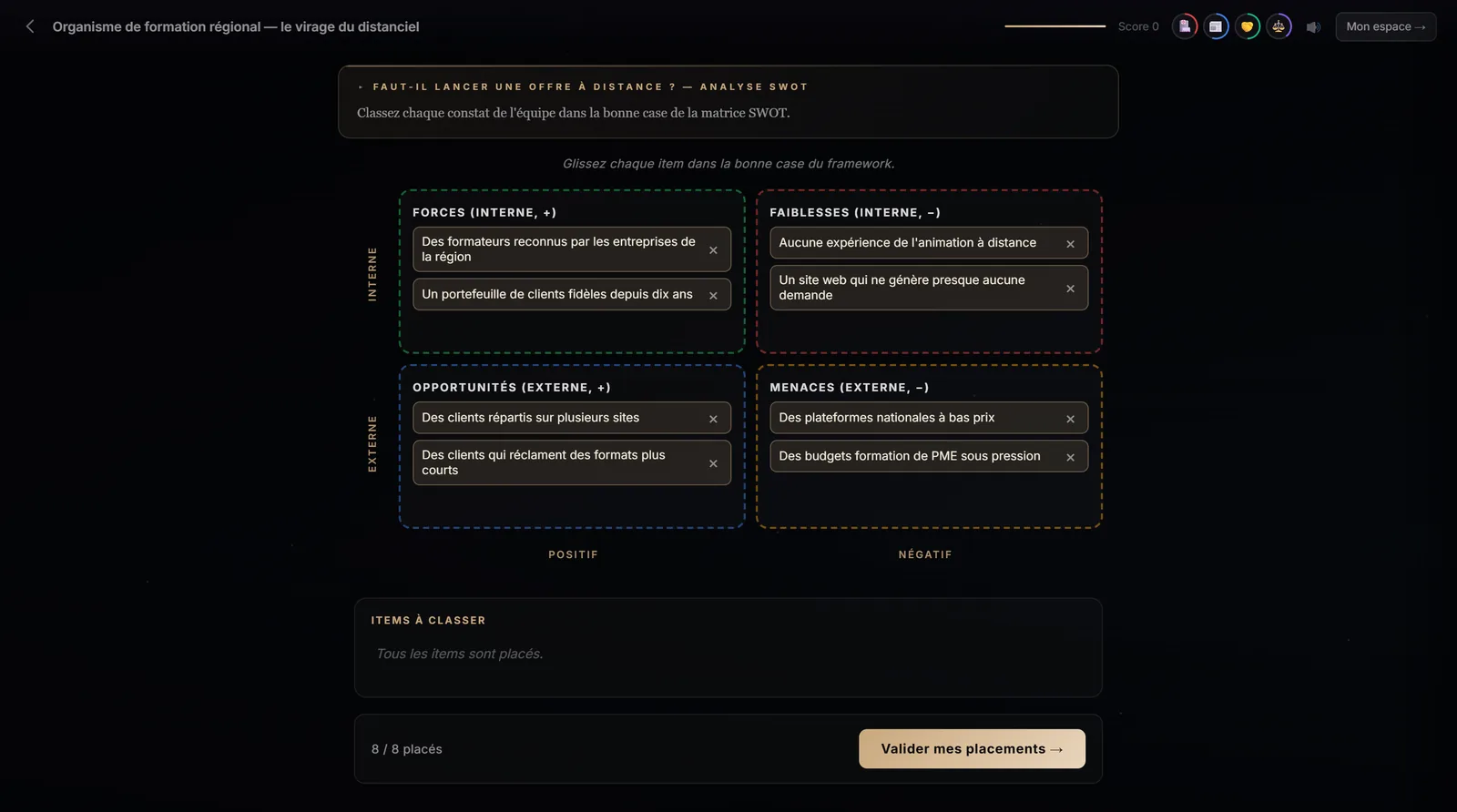
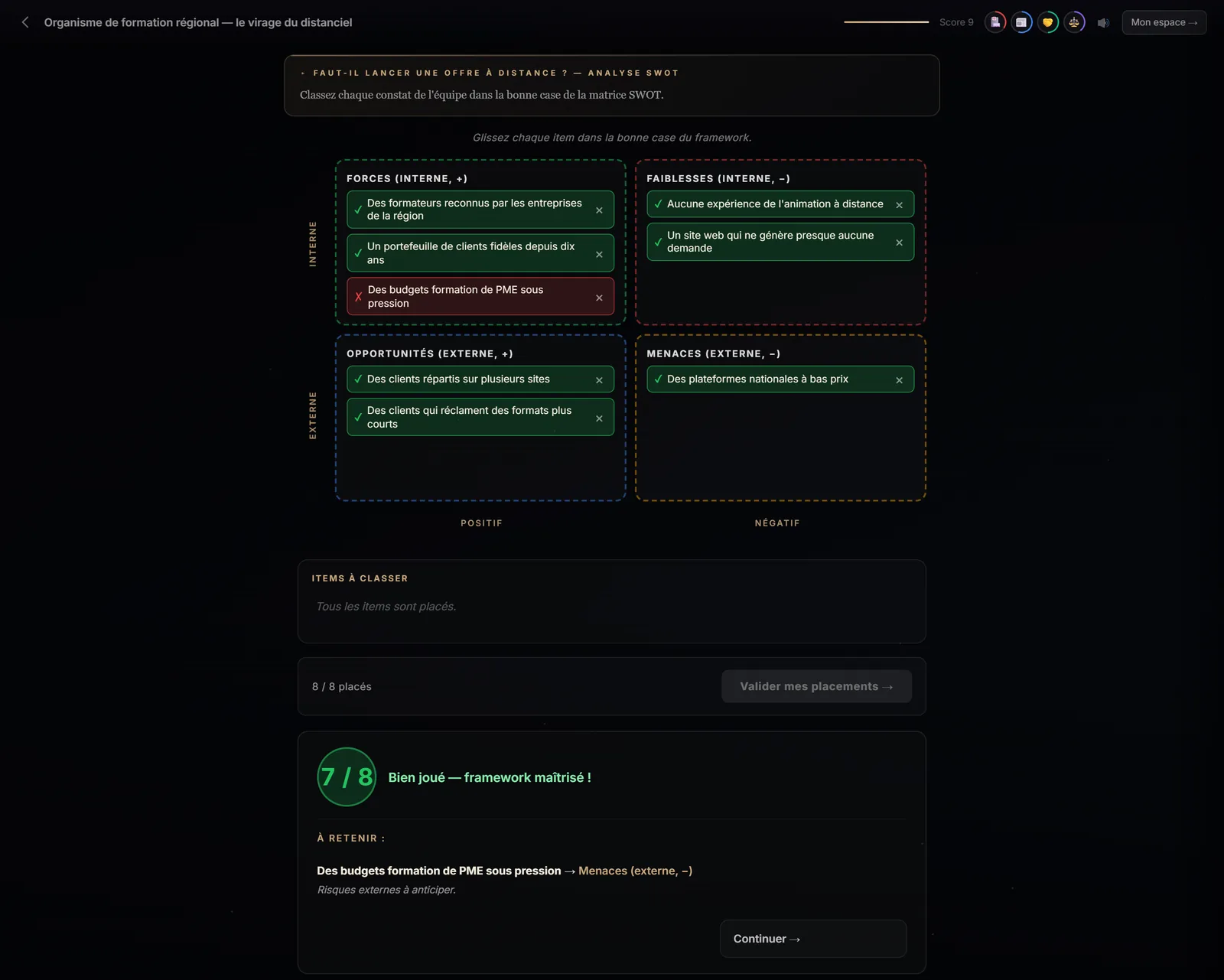
The SWOT matrix (Strengths, Weaknesses, Opportunities, Threats) sorts the findings of an analysis into four boxes along two axes: internal or external to the organisation, positive or negative. Strengths and weaknesses belong to the organisation itself; opportunities and threats come from its environment. In an Immersio serious game, learners sort the findings of a situation before making a strategic decision.
At a glance
- Origin
- Strategic planning, 1960s (authorship debated).
- Axes
- Internal / external × positive / negative.
- Boxes
- Strengths · Weaknesses · Opportunities · Threats.
- Skills
- Analysis, synthesis, strategic decision-making.
- Audiences
- Executives, sales managers, project leaders, entrepreneurs.
What is the SWOT matrix?
SWOT stands for Strengths, Weaknesses, Opportunities, Threats. It emerged from strategic planning work in the United States in the 1960s; its exact authorship is still debated. Its principle rests on two axes:
| Positive | Negative | |
|---|---|---|
| Internal (what the organisation controls) | Strengths | Weaknesses |
| External (what comes from the environment) | Opportunities | Threats |
SWOT isn't an end in itself: it's a step before the decision. A good analysis leads to a simple question, such as “how can we use our strengths to seize this opportunity without exposing ourselves to that threat?”.
Why practise SWOT in a serious game?
Because the difficulty isn't knowing the four boxes, but classifying a real finding. “Customers spread across several sites”: is it a strength of the training provider, or a market opportunity? The answer depends on what the organisation controls, and that internal / external distinction is what makes an analysis good.
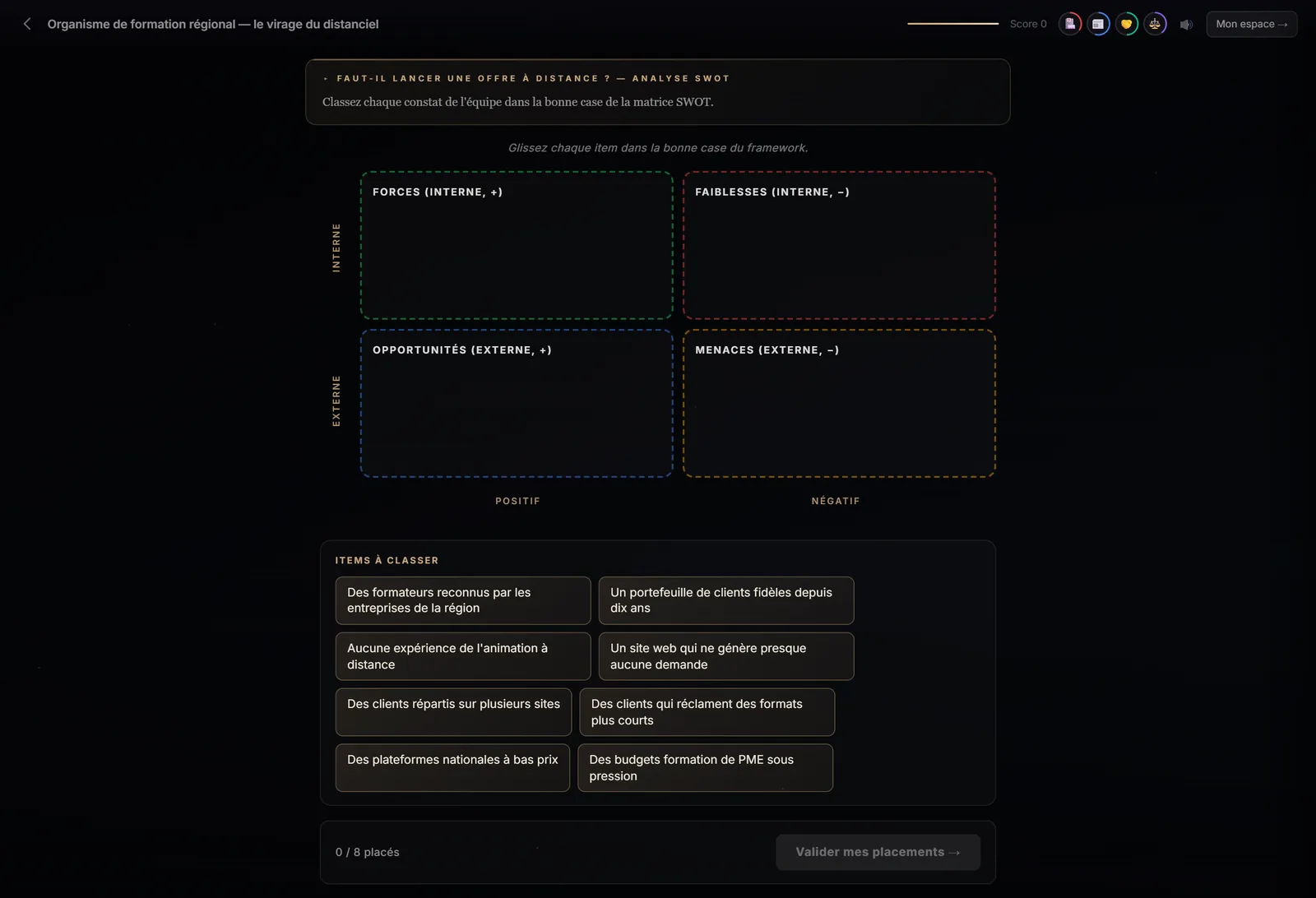
Placed in a scenario, SWOT takes on its real role: preparing a decision. The learner sorts the findings, then has to decide in the next scene, with what that implies for the gauges.
What are the most common mistakes?
- Confusing strength and opportunity. A strength belongs to the organisation (a team, know-how); an opportunity is an external development it can seize.
- Confusing weakness and threat. A lack of in-house skills is a weakness; the arrival of a low-cost competitor is a threat.
- Vague findings. “Good reputation” doesn't support a decision; “trainers recognised by companies in the region” does.
- Analysis without a decision. A SWOT that leads to no choice has served no purpose.
Which courses should use SWOT?
- Strategy and leadership: launching an offer, entering a market, responding to a competitor.
- Business development: preparing a key meeting, analysing a key account.
- Entrepreneurship: testing a plan to start or take over a business.
- Training for elected officials and non-profits: deciding on a project with limited resources.
Create a serious game for branch directors of a regional training provider. The management committee must decide whether to launch a distance-learning offer. The learner must first sort their team's findings into a SWOT matrix, then defend a decision before the director and handle its consequences. Gauges: financial health, customer satisfaction, trainer motivation.
Paste it into the studio once your account is created, then adapt it to your audience. Scenarios are generated in French.
The limits of SWOT
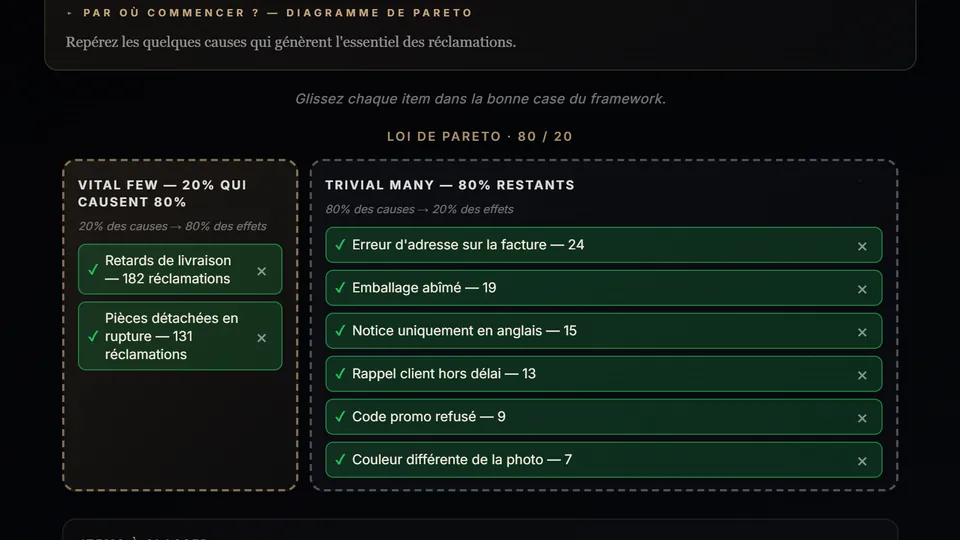
SWOT doesn't rank: it puts a minor threat on the same level as a vital one. It also depends on point of view: what is a strength for one company can be a weakness for another. To rank the causes of a problem, the Pareto chart is better suited.
Frequently asked questions
What does SWOT stand for?
Strengths, Weaknesses, Opportunities, Threats.
What's the difference between a strength and an opportunity?
A strength is internal: it belongs to the organisation and depends on it. An opportunity is external: a development in the environment (market, regulation, technology) that the organisation can seize.
Is SWOT suitable for beginners?
Yes, provided you work with concrete, limited findings. Immersio's engine doesn't add a matrix at beginner level in automatic mode, but you can require one in custom mode.
Create your first scenario
A training provider account gives you the studio, the scene formats and all four matrices. 7-day free trial, no credit card required, with 3 scenario generations to judge the result on your own topic. Scenarios are generated in French.
Create a training provider accountPrefer to compare first? See pricing · How it works