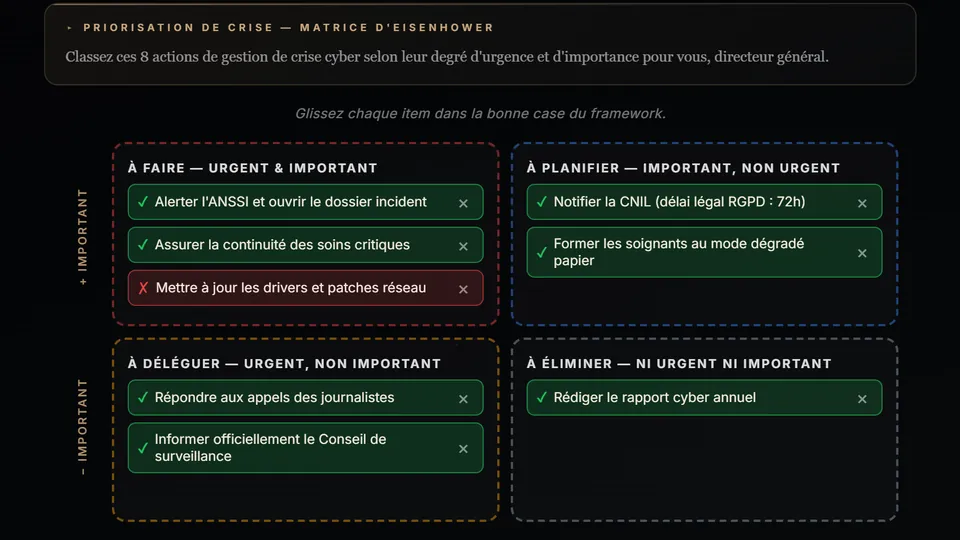
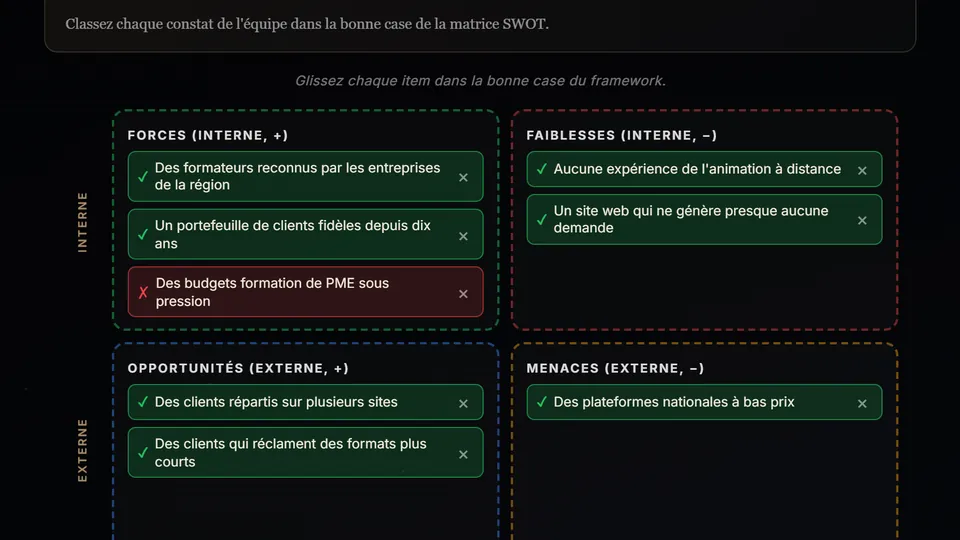
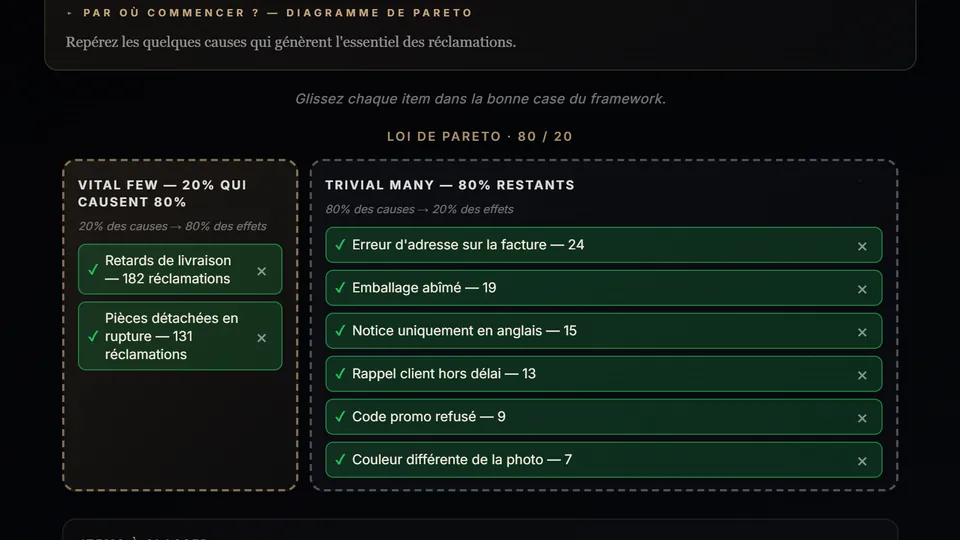
In short
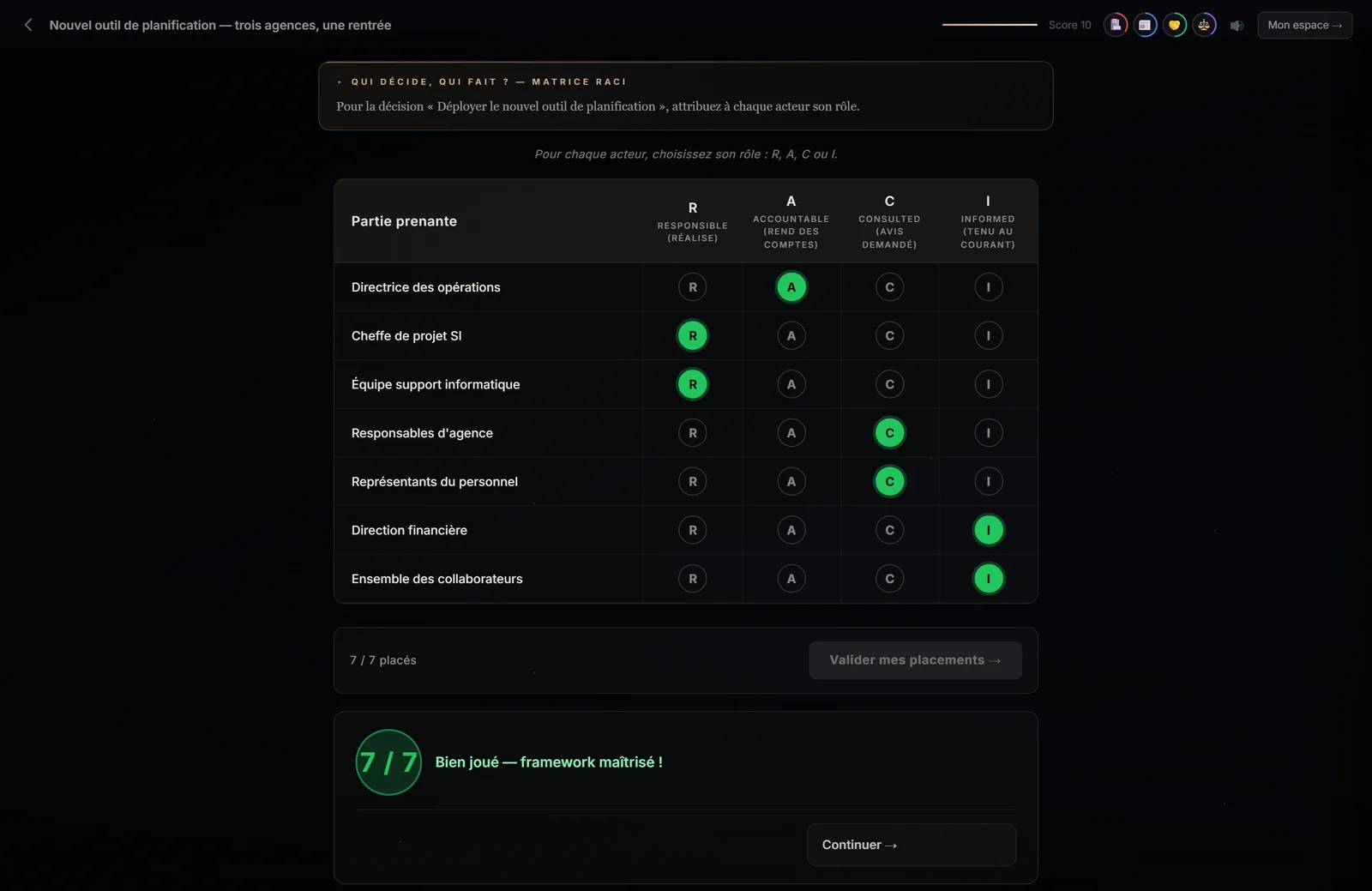
The RACI matrix assigns each person involved in a task or decision one of four roles: R (Responsible, does the work), A (Accountable, answers for it and makes the call; one person per task), C (Consulted, gives an opinion before the decision) and I (Informed, is told afterwards). In an Immersio serious game, learners assign these roles to the characters in the situation, row by row, then see their mistakes corrected.
At a glance
- Origin
- A classic project management tool (responsibility assignment matrix).
- Roles
- Responsible · Accountable · Consulted · Informed.
- Golden rule
- Only one A per task.
- Skills
- Delegation, organisation, project management, communication.
- Audiences
- Project managers, managers, cross-functional roles, change management.
What do the four letters of RACI stand for?
| Letter | Role | What they do | Communication |
|---|---|---|---|
| R | Responsible | Does the actual work; there can be several. | — |
| A | Accountable | Makes the call and bears final responsibility; only one per task. | — |
| C | Consulted | Gives an opinion before the decision. | Two-way |
| I | Informed | Is kept up to date after the decision. | One-way |
The matrix reads as a table: one row per person (or per task), one column per role. Its value lies less in the letters than in the conversations it triggers: filling in a RACI forces people to say out loud who decides, which many organisations would rather leave vague.
Why practise RACI in a simulation?
Because on paper RACI is obvious; in a real organisation it's political. Should staff representatives be consulted or just informed? Should the finance department approve, or be kept in the loop? These questions only have answers in a specific context, with characters and stakes. That's what the scene provides.
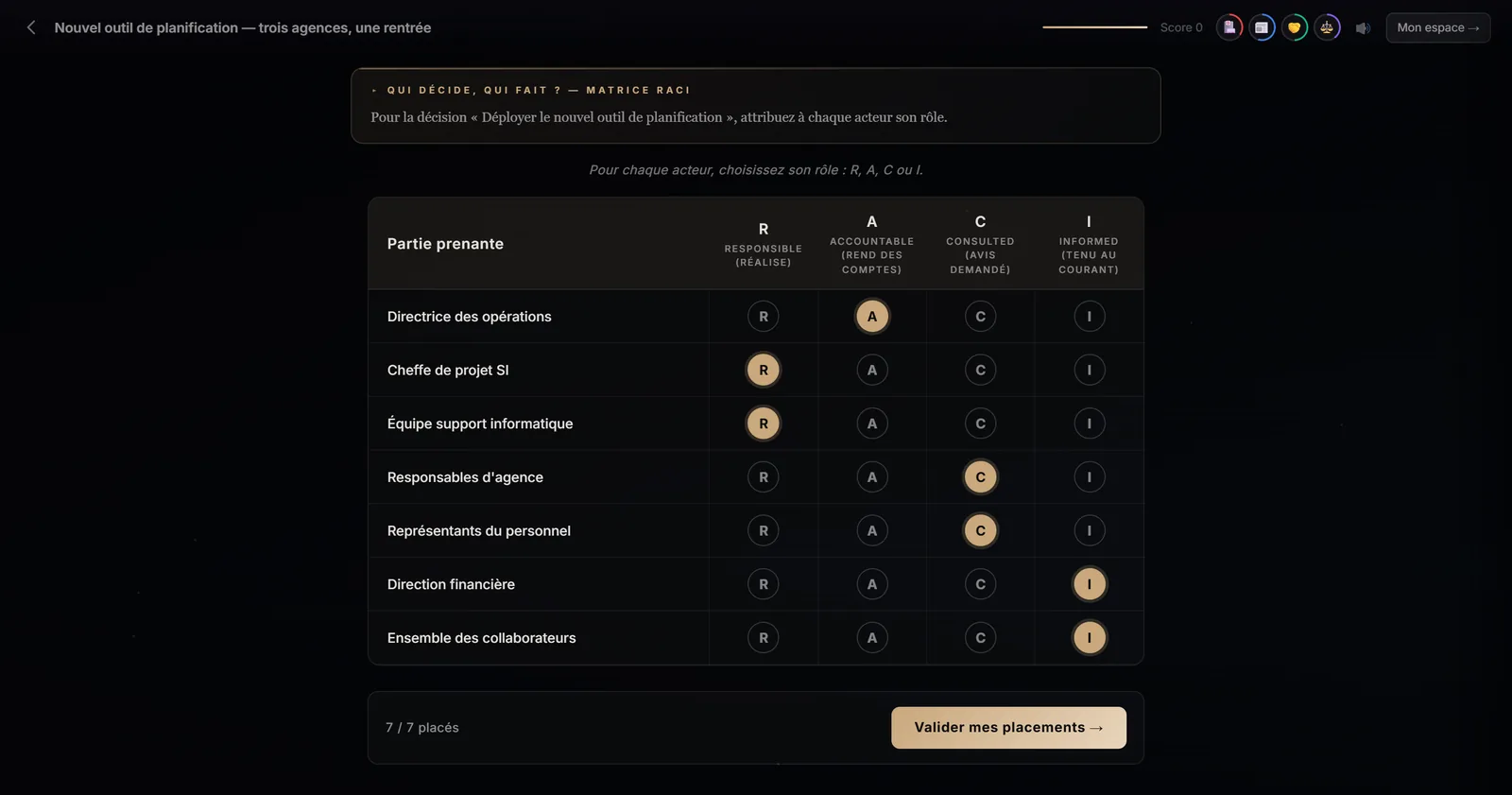
The scene's format fits the tool: no drag and drop, but a table where the learner picks each person's letter. On submitting, each row is marked right or wrong, and mistakes are explained.
What are the classic RACI mistakes?
- Several A's on the same task. If two people make the call, nobody does: it's the first cause of deadlock.
- Confusing C and I. Consulting means asking for an opinion before deciding; informing means telling afterwards. Consulting someone you only inform creates frustration; the reverse creates distrust.
- Too many C's. Each person consulted lengthens the decision; a RACI that consults everyone paralyses the project.
- No R. A task someone “owns” but nobody actually does doesn't move.
Which courses should use RACI?
- Project management: launching a cross-functional project, taking over a late project.
- Change management: a tool roll-out, a reorganisation, an office move.
- Management: learning to delegate without losing control, clarifying a team's roles.
- Crisis management: who decides, who executes and who communicates when everything moves fast.
Create a serious game for project managers taking over the roll-out of a new scheduling tool across three branches, several months late because nobody knew who was supposed to make the call. The learner must clarify everyone's role in a RACI matrix, then handle the difficult conversations that follow with branch managers and senior management. Gauges: deadlines, team buy-in, management's trust.
Paste it into the studio once your account is created, then adapt it to your audience. Scenarios are generated in French.
The limits of RACI
A RACI describes a split of roles at a given moment: it says nothing about the quality of relationships or how to consult or inform. That's why a RACI scene works well followed by a dialogue, where the learner has to tell someone they will only be informed. The expected classification is the one defined when the scenario was created: have it reviewed if your organisation has its own conventions.
Frequently asked questions
Can there be several “A”s in a RACI matrix?
No, not for the same task: the Accountable is the person who makes the call and answers for it, and there should be only one. There can, however, be several “R”s doing the work.
What's the difference between Consulted and Informed?
The Consulted gives an opinion before the decision: communication goes both ways. The Informed is told afterwards: communication goes one way.
How does the learner fill in a RACI on Immersio?
In a table: one row per person, one column per letter. They choose each row's letter, submit, then see every assignment confirmed or corrected.
Create your first scenario
A training provider account gives you the studio, the scene formats and all four matrices. 7-day free trial, no credit card required, with 3 scenario generations to judge the result on your own topic. Scenarios are generated in French.
Create a training provider accountPrefer to compare first? See pricing · How it works